We deliver value.
Trust companies, Luxembourg
Trust company digitalisation: eHub Apps brings its daily work into a single platform
It is no longer only about invoices. Incoming mail, bank statements, invoicing, Intrastat, tax returns, domiciliation, onboarding, transaction monitoring: eight modules, one login, one client base, and an artificial intelligence engine that reads the documents, hosted in Europe.

In short
What is eHub Apps?
eHub Apps is a platform published by Empirys for Luxembourg trust companies. It brings eight business modules together (incoming mail, bank statements, invoicing, Intrastat, personal income tax returns, domiciliation, onboarding and transaction monitoring) behind a single login and a single client base.
A trust company runs five to ten regulated activities in parallel. Each has its own tool, its own login, its own client base, and none of them talk to each other: the client is keyed in everywhere, and a document filed in one place exists nowhere else. eHub Apps removes that duplicate entry.
The keying-in is done by an artificial intelligence engine hosted in Europe: it reads the document, recognises the client, the date, the type and the amount, and stops there. You approve, it sends nothing of its own accord, and no data leaves the perimeter. That is the question your own client will ask you, and you will be able to answer it in writing.
The modules
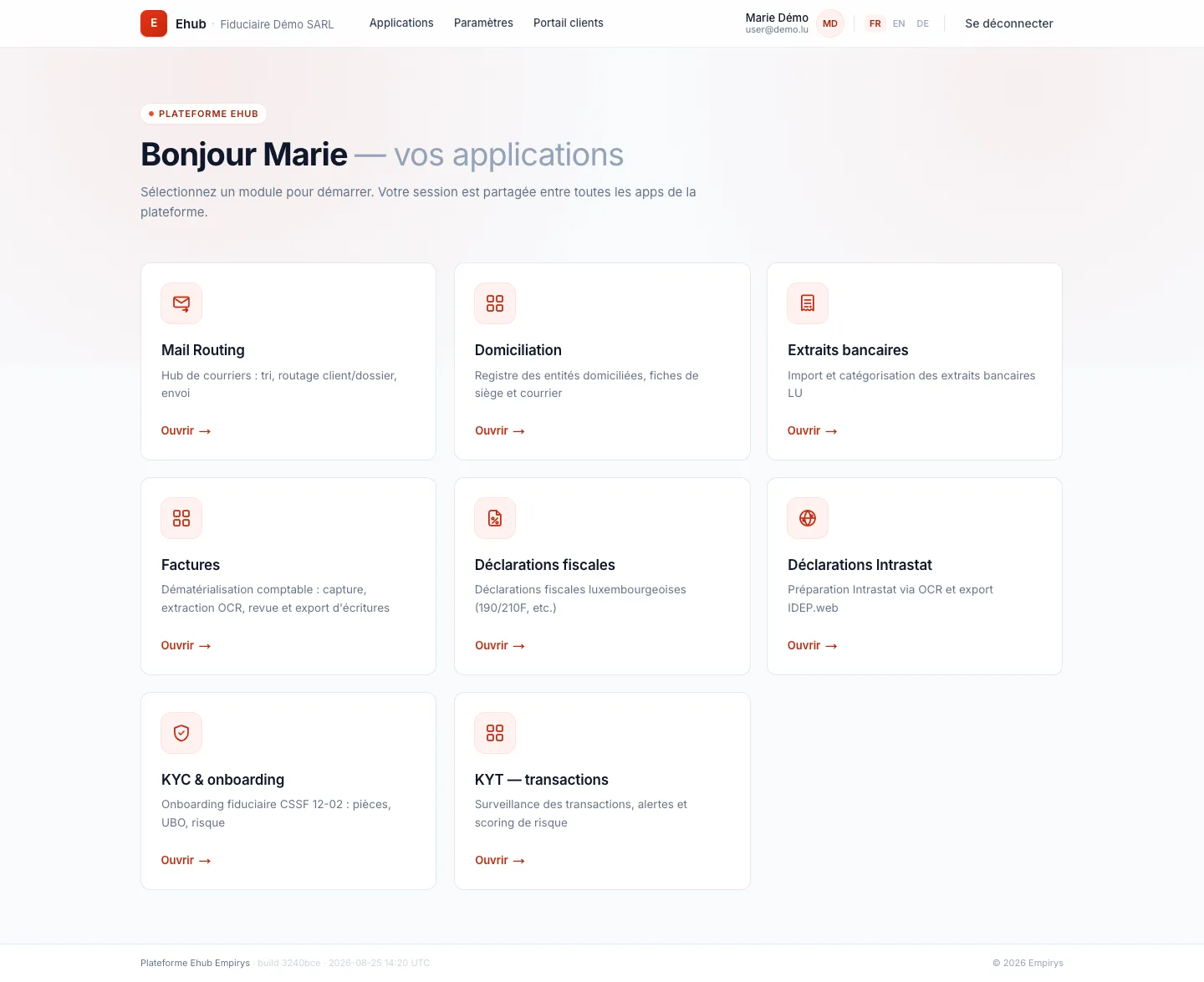
Eight modules, built and working
The order below is the platform’s own, and it carries the argument: MailRouting comes first because it is what feeds the others.
| Module | The job it does |
|---|---|
| MailRouting | sorting and routing of incoming mail: it feeds the six other modules |
| Extraits | bank statements, reading and reconciliation |
| Factures | invoicing |
| Intrastat | Intrastat returns, automatic reading of invoices |
| Impôts | personal income tax returns: form 100F and its schedules (190/210F, 180F, 700F), Luxembourg tax law year by year. No corporate income tax |
| Domiciliation | domiciliation, with an external client-facing side |
| KYC | onboarding and CSSF-compliant customer due diligence: questionnaire, AML/CFT scoring, document grid |
| KYT | transaction monitoring, multi-country and multi-bank statements |
| + client portal | an external space for the trust company’s own clients, outside the eHub Apps brand |
The central argument
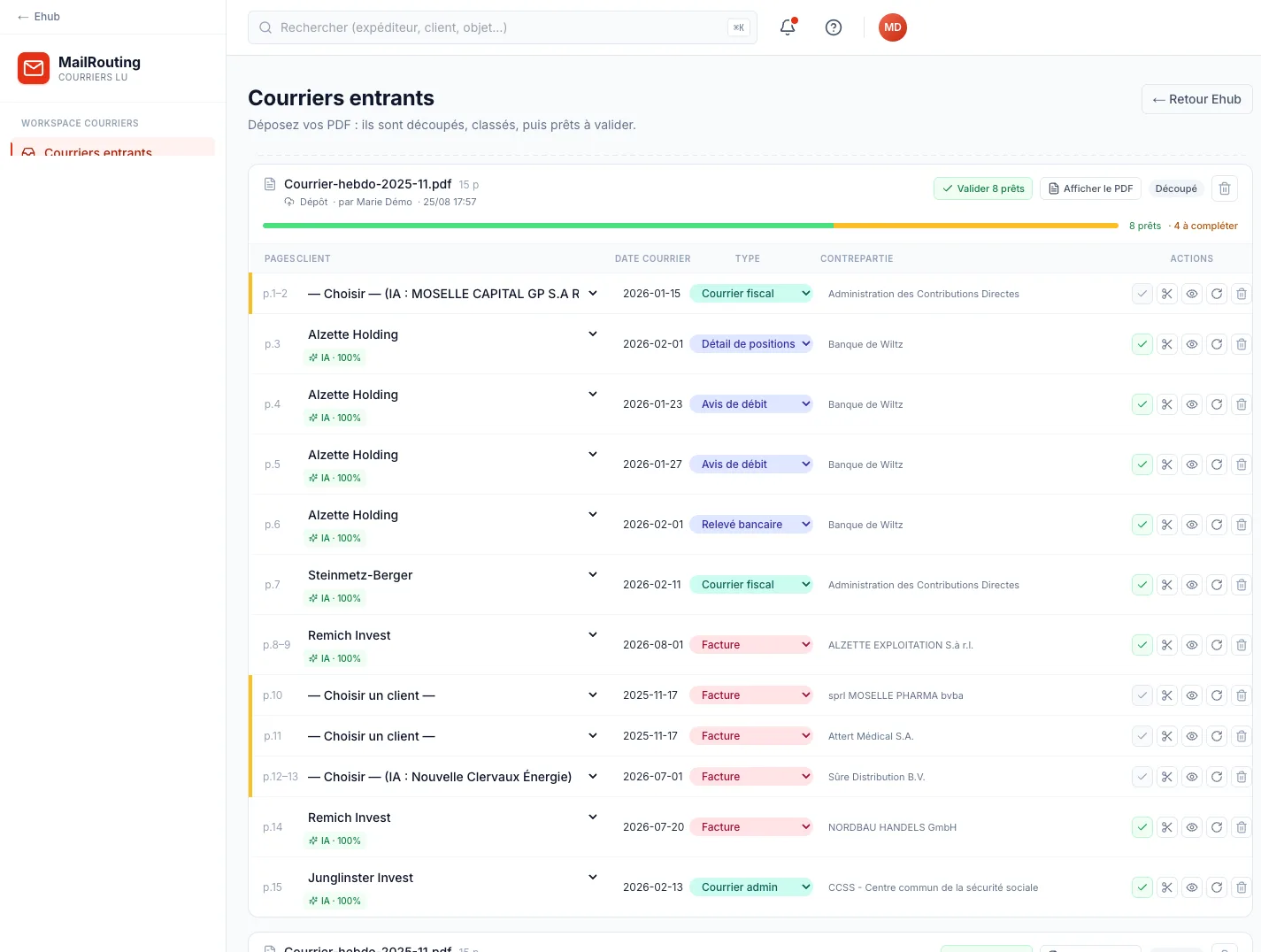
The mail arrives once, and MailRouting sends it on to the modules concerned. A document filed once serves everywhere: nobody files it again, nobody keys it in again, and there are never two versions of it.
What changes for you
Six questions you are asking, answered on screen
Each one can be checked in a demo, on your own files. The technical detail is in brackets, for your IT provider if they want to look at it.
Your staff open one session, not eight
The client is keyed in once and holds good for every module. The home screen only shows the ones you have enabled. One contact, one contract, one directory.
One client’s files cannot show up under another’s
The separation is set in the database itself, not left to a developer staying alert: a badly formed query does not return the neighbour’s file, it returns nothing at all. (PostgreSQL Row-Level Security, on every schema.)
Your data stays in Europe, the artificial intelligence included
The platform is hosted in France, and the AI engine also runs in a European region. Nothing goes anywhere else. This is what your client, their lawyer or their DPO will come and check. (Azure Container Apps, France Central region.)
The AI does the keying-in, you keep the decision
It recognises the client, the date, the document type and the amount, and stops there. Every screen opens on what is waiting for your approval; nothing goes out without a human having seen it.
A filed document is not lost, and the statutory periods are kept
Nothing is erased: what comes in stays available. Retention follows your obligations: five years for AML/CFT, ten years for Luxembourg accounting.
What worked last month still works
The journeys that matter (filing, splitting, matching, approval, export) are replayed automatically at every change to the platform, before it reaches you.
Personal income tax: what sets us apart
The totals on form 100F are not retyped by hand into our code: they are derived from the formulas the official ACD form carries itself. The form is its own arbiter: if the ACD changes a calculation from one tax year to the next, the divergence shows instead of spreading.
In practice
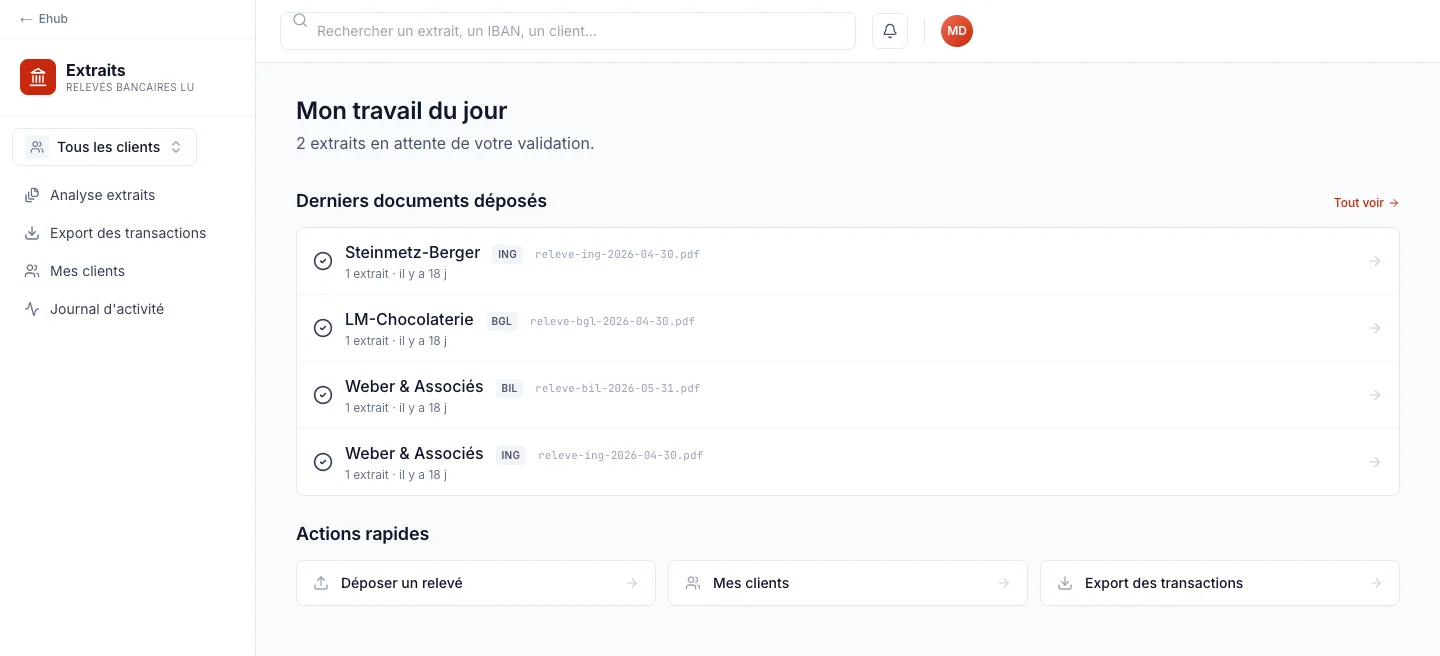
Today’s work, module by module
Each module opens on what is waiting for a human decision. Documents arrive through MailRouting, the module processes them, and the entry stays in one place for all the others.
Where we stand
The eight modules are built and working. Development is coming to an end and the platform is entering its testing phase. We are now looking for a few early-adopter trust companies, set on digitising their practice, to put eHub Apps through their own files and shape what is left to build.
Frequently asked questions
Frequently asked questions
Is eHub Apps only about processing invoices?
No. Invoicing is one module out of eight. The platform also covers incoming mail, bank statements, Intrastat, personal income tax returns, domiciliation, onboarding and transaction monitoring.
Does our data leave Europe?
No. The platform is hosted in France, and the artificial intelligence that reads your documents also runs in a European region. Nothing is sent anywhere else. That is the answer you will be able to give in writing to a client, their lawyer or their DPO.
Can one of our clients see another client’s file?
No, and the separation is not left to the code: it is set in the database itself. A badly formed query does not return the neighbour’s file, it returns nothing at all.
Can a document be deleted by mistake?
No. What is filed stays available: nothing is erased. Retention follows your obligations: five years for AML/CFT, ten years for Luxembourg accounting.
Does the tax module cover corporate income tax?
No. It handles personal income tax returns: form 100F and its schedules (190/210F, 180F, 700F), under the Luxembourg tax law of the year concerned.
Is a separate contract needed for each module?
No. One login, one client base, and a launcher that only shows the modules enabled for the trust company.
Is eHub Apps available today?
Development is coming to an end and the platform is entering its testing phase. We are looking for early-adopter trust companies to put it through their own files.
A 30-minute demo, on your own data
Every claim on this page can be shown on screen within the minute. No commitment. Over a coffee if you prefer.
Direct contact
Phone
Sales e-mail
Technical support
Address
2 Am Brill, L-3961 Ehlange-sur-Mess